
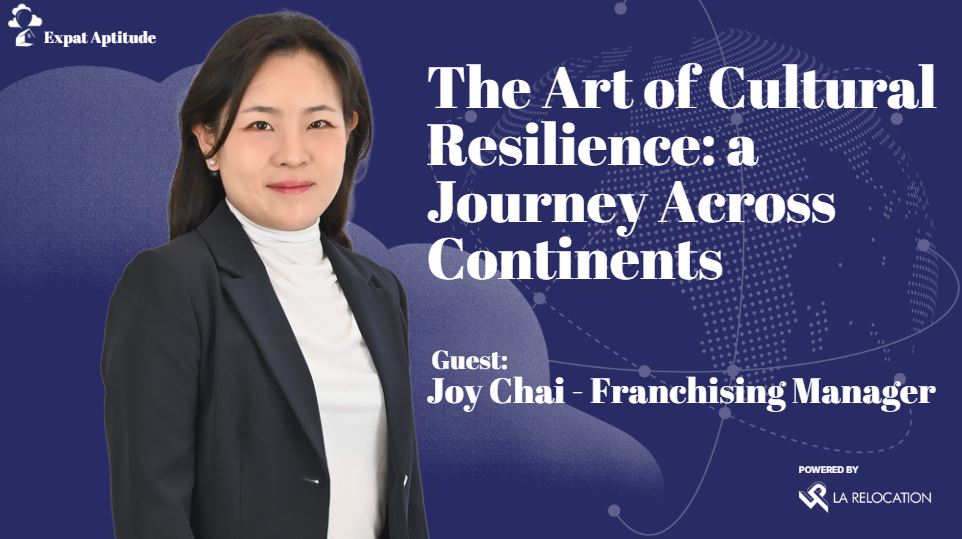
Moving abroad is often described as an exciting adventure. In reality, it’s also a continuous process of adaptation, self-discovery, and learning to navigate different ways of living.
In this episode of Expat Aptitude, Joy Chai shares her journey of cultural resilience as an expat from South Korea, navigating life in the UK, Ireland, and Switzerland. Today she lives in the German-speaking part of Switzerland while working in the Italian-speaking region, experiencing every day what it truly means to live between cultures.
Her story goes far beyond relocation. It is about developing cultural resilience: the ability to adapt to new environments while remaining authentic to who you are.
Watch the full episode on YouTube or listen to it on Spotify.
This Podcast Episode Main Content
In an increasingly globalized world, the ability to adapt and thrive in diverse cultural environments is more important than ever. In this episode of Expat Aptitude, host Vera Allievi speaks with Joy Choi, whose life story exemplifies cultural resilience. Through her experiences across South Korea, the UK, Ireland, and Switzerland, Joy shares insights and lessons that inspire us to appreciate the beauty of cultural diversity.
Cultural resilience is built, not inherited
One of the strongest messages from the conversation is that cultural resilience doesn’t appear overnight.
It develops through everyday experiences, small adjustments, misunderstandings, curiosity, and the willingness to keep learning.
For Joy, every country brought different challenges. In Ireland and the UK, language was never a major obstacle, allowing her to focus on understanding workplace culture and building relationships. Switzerland presented a different reality, where learning the local language became essential for feeling integrated and fully participating in daily life.
Rather than seeing these differences as barriers, she gradually learned to see them as opportunities for personal growth.
The biggest culture shocks are often the smallest things
When people think about culture shock, they often imagine major differences in traditions or customs.
Joy’s experience reminds us that the biggest surprises often come from ordinary, everyday situations.
Coming from Seoul, where almost everything is available digitally and around the clock, adapting to slower administrative processes in Europe required patience.
At the same time, she discovered aspects of European life that quickly became meaningful: neighbours greeting each other on the street, historical city centres becoming part of everyday life, and the close connection with nature that characterises many parts of Switzerland.
These seemingly small moments gradually became part of her new normal.
Switzerland: international, yet deeply local
Switzerland is often perceived as one of Europe’s most international countries.
Joy’s experience paints a more nuanced picture.
She explains that every canton has a strong identity, traditions are deeply respected, and integration often starts with embracing the local language and culture rather than relying on English alone.
Interestingly, she also argues that this diversity makes Switzerland naturally resilient. Living with four national languages and distinct regional identities creates an environment where cultural differences are part of everyday life, even if they are not always immediately visible.
Living abroad also means discovering yourself
Perhaps the most personal part of the conversation is Joy’s reflection on identity.
She explains that moving abroad allowed her to step outside the roles that had always defined her: daughter, sister, friend.
Building a new life from scratch forced her to ask a simple but powerful question:
Who am I when nobody already knows me?
Each country, each language and each new experience became another piece of that answer.
Rather than replacing her identity, every culture added another layer to it.
As Joy beautifully describes it, every experience becomes another “badge” collected throughout life.
Practical advice for future expats
Drawing on her own experience, Joy also shares practical suggestions for anyone planning a move to Switzerland:
- Learn the local language of the canton where you will live or work.
- Understand that privacy and planning are highly valued in Swiss culture.
- Don’t interpret reserved behaviour as unfriendliness.
- Respect punctuality.
- And if a Swiss person invites you for a “walk”, be prepared… it might actually be a hike.
These may sound like small details, but they often make the difference between simply living in a country and truly integrating into it.
Expat Aptitude is a mindset
When asked what “Expat Aptitude” means to her, Joy offered a definition that perfectly captures the spirit of the podcast.
Being an expat is not simply about changing countries.
It is about being comfortable outside your comfort zone, accepting uncertainty, staying curious, and trusting that every challenge will eventually become part of your personal story.
For anyone considering an international move, already living abroad, or supporting employees through relocation, this episode is a reminder that successful mobility is not only about logistics.
It is about people.
And sometimes, the greatest destination is discovering a new version of yourself along the way.