
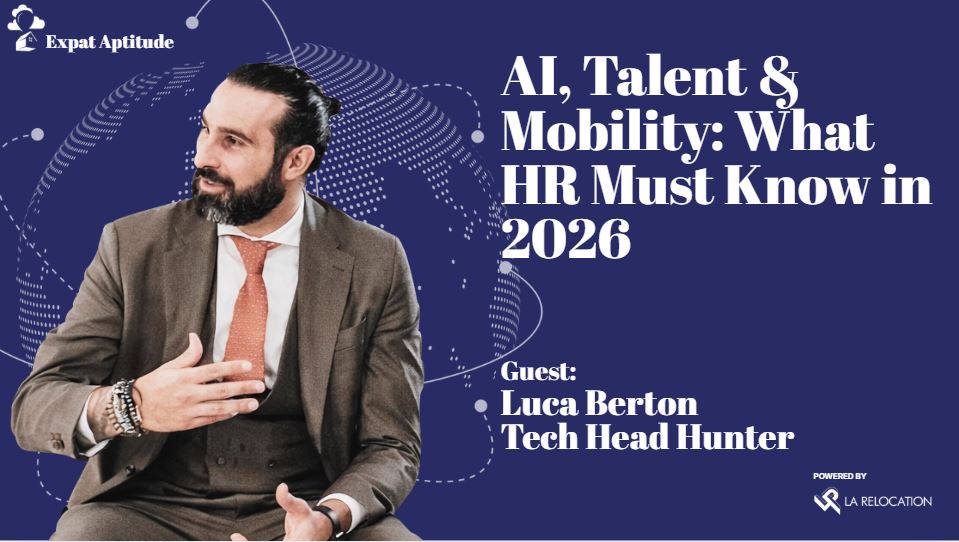
The world of tech recruitment has changed dramatically over the past few years. Companies are no longer hiring only for technical expertise; they are searching for professionals who can adapt, collaborate, and grow in increasingly international and AI-driven environments.
In a recent episode of thwe Expat Aptitude podcast by La Relocation Group, Vera Allievi sat down with Luca Berton, Principal for the Technology & Digital Practice at Chaberton Professionals, to discuss how artificial intelligence, global mobility, and evolving candidate expectations are transforming the recruitment landscape across Europe.
Watch the full episode on YouTube or listen to it on Spotify.
This Podcast Episode Main Content
The Evolution of Tech Recruitment
According to Luca Berton, one of the biggest transformations in recruitment has been the shift from skills-based hiring to a more capabilities-driven approach.
A few years ago, companies focused heavily on finding candidates with expertise in very specific technologies. Today, however, adaptability and learning agility have become just as important as technical skills.
With the rise of AI and automation, organizations are increasingly looking for professionals who can:
- adapt quickly to changing technologies
- work effectively in data-driven environments
- collaborate with AI-powered tools
- solve complex problems creatively
- lead innovation across international teams
This evolution has also expanded competition globally. Tech talent is no longer limited by geography, and companies are now competing internationally to attract the best candidates.
Why Tech Candidates Choose International Opportunities
One of the most interesting points raised during the conversation was how candidate priorities have changed.
Salary remains important, but it is no longer the primary factor driving international career decisions. Luca explains that candidates are now placing greater value on:
- career acceleration
- flexibility and hybrid work
- autonomy
- long-term quality of life
- meaningful professional projects
For many professionals, relocation decisions are deeply connected to personal and family well-being. Issues such as school systems, partner career opportunities, healthcare, and community integration often influence the final decision as much as the role itself.
This reflects a broader shift in international mobility: relocation is no longer viewed simply as a logistical process, but as a complete life transition.
Relocation as Part of the Tech Talent Strategy
During the episode, Luca emphasizes that relocation support should not be treated as an administrative afterthought.
Companies that succeed in attracting and retaining international talent are often those that invest in the full relocation experience.
Effective relocation support may include:
- housing assistance
- school guidance for families
- immigration and administrative support
- integration into the local community
- clear communication throughout the process
- dedicated support contacts for employees and families
When organizations approach relocation strategically, employees tend to integrate faster, perform more effectively, and remain with the company longer.
From the perspective of La Relocation Group, this human-centered approach can significantly improve both employee satisfaction and long-term retention.
The Human Challenges Behind International Hiring
Beyond logistics, international recruitment also creates cultural and organizational challenges.
Luca points out that alignment is often the biggest difficulty companies face. International tech professionals are frequently accustomed to agile and fast-paced work cultures, while some organizations still operate with slower or more traditional decision-making processes.
This can create friction during onboarding and integration.
Another key challenge is employer branding. In today’s global market, companies must actively communicate their vision, culture, and long-term opportunities in order to attract highly sought-after digital talent.
Organizations also need internal readiness. Hiring internationally only works when leadership teams are genuinely prepared to embrace diverse perspectives and multicultural collaboration.
How Artificial Intelligence Is Changing Recruitment
Artificial intelligence is now influencing nearly every stage of recruitment and talent management.
However, Luca highlights an important point: while AI is transforming processes, human capabilities remain irreplaceable.
In the coming years, HR managers will likely focus on evaluating:
- AI-readiness
- adaptability
- communication skills
- empathy
- leadership
- collaborative thinking
Technical expertise alone will not be enough. The ability to work alongside AI tools while maintaining strong interpersonal skills will become increasingly valuable.
This creates a fascinating paradox: the more technology evolves, the more important human connection becomes.
The Growing Importance of Flexibility and Remote Work
The conversation also explored the future of international hiring models.
Cross-border remote work is becoming increasingly common, allowing companies to access talent globally without always requiring physical relocation. In some cases, relocation may become optional rather than mandatory.
Still, even in remote-first environments, companies must continue investing in employee experience, inclusion, and cultural integration. International teams need structure, communication, and a sense of belonging to perform successfully.
This means HR and mobility teams will continue playing a crucial role in helping organizations manage distributed workforces effectively.
To Sum Up
The future of tech recruitment is no longer defined only by technical skills or hiring speed. It is increasingly shaped by adaptability, international mobility, human connection, and the ability to navigate constant change.
As Luca Berton explains in this episode, successful companies are those that combine innovation with a strong people-centered approach.
Artificial intelligence may transform the way organizations recruit and work, but long-term success still depends on understanding people: their motivations, ambitions, and need for belonging.
In many ways, this is where global mobility and recruitment intersect most powerfully — creating environments where talent can thrive professionally and personally.
Key Takeaways
- Tech recruitment is shifting from skills-based hiring to capabilities-driven hiring
- Adaptability and AI-readiness are becoming essential professional qualities
- Candidates increasingly prioritize flexibility, career growth, and quality of life
- Relocation support plays a major role in talent attraction and retention
- International hiring requires strong cultural alignment and employer branding
- Human skills such as empathy and communication remain critical in AI-driven workplaces
- Cross-border remote work is reshaping the future of global recruitment
Want to know more about how international mobility can support your company’s talent strategy? La Relocation Group can help you create a tailored relocation experience for international employees and their families.